On 27 July we gave a Telegram bot several everyday work tasks. There were no specially prepared questions designed to make any system look smarter than a marketing department. It had to find channels, collect material, write a post, create a cover and schedule publication.
Test date: 27 July 2026. White Studio prepared this article from a real Telegram conversation.
The results were revealing. The bot handled search and draft work well, but at one point substituted a similar answer for the actual task: instead of rental accommodation, it suggested buying investment property. These are precisely the incidents that make testing worthwhile.
Below is the complete review with screenshots. Subscriber counts, links and wording are reproduced as the bot showed them during the conversation. We do not treat them as automatically verified facts.
What exactly we tested
We tested Angels_bot. In its own description it said that it used the OpenAI API, but did not identify the precise internal model version.
- Find five large Russian-language Telegram channels or groups for people living abroad.
- Find five offers of rental accommodation in Thailand within these communities.
- Collect ten recent news items about Russia from major channels.
- Prepare a post about chatbots and their benefits for businesses.
- Create a cover and schedule the post for the following day.
We also asked the bot to monitor feedback and answer questions. This is particularly important: writing text is one thing; gaining channel access and acting on a company's behalf is another.
Finding Telegram channels: a quick starting point, not a finished database
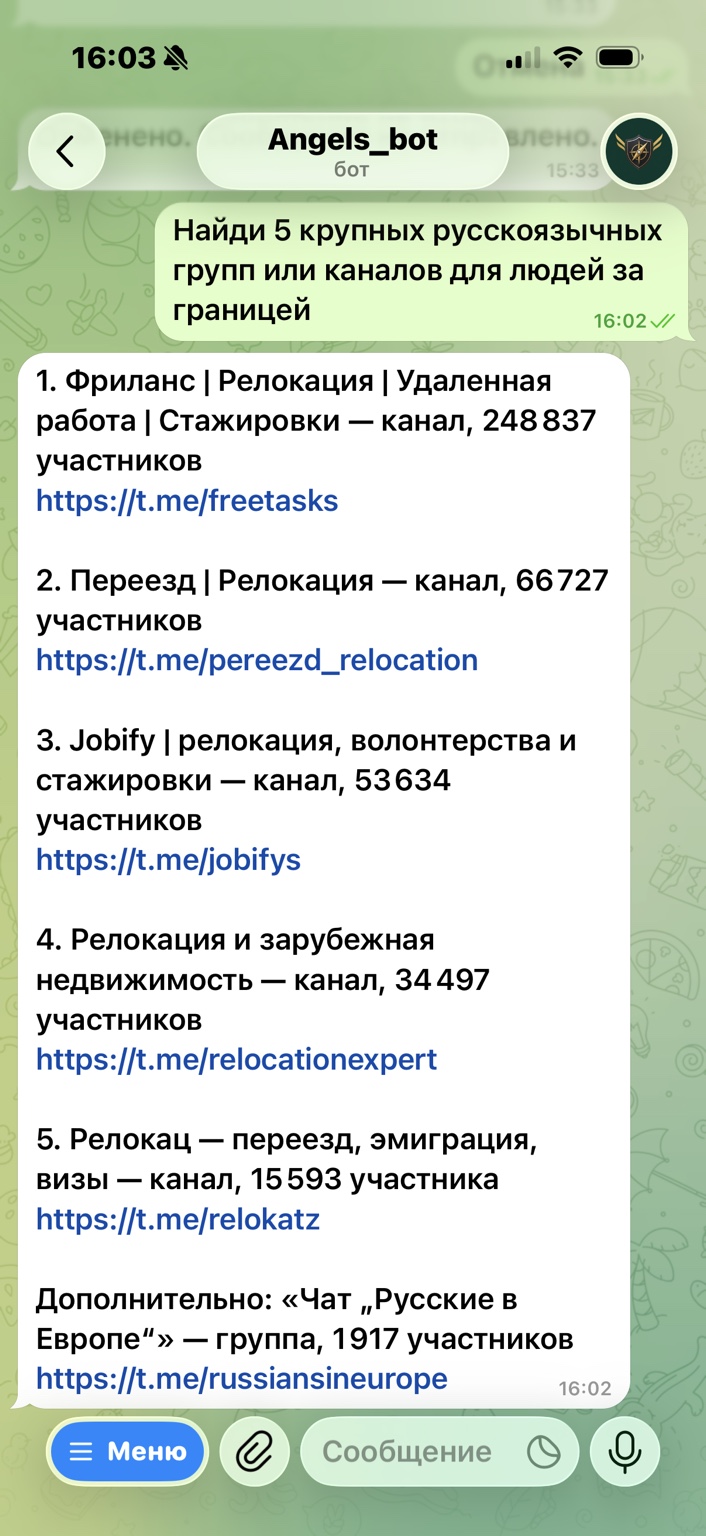
The bot completed the first task in a few seconds. It suggested channels about relocation, remote work, overseas property and moving abroad, giving a link and member count for each.
This kind of search saves time at the initial stage. Instead of manually working through dozens of results, we immediately have a shortlist. But it is too early to buy advertising or build a media plan solely on this answer.
Before working with a channel, check its last post date, genuine views, audience interests, advertising terms and signs of artificial growth. A large subscriber count guarantees nothing by itself. Sometimes it represents an audience; sometimes a collection of long-forgotten accounts.
Renting in Thailand: where the bot missed the mark
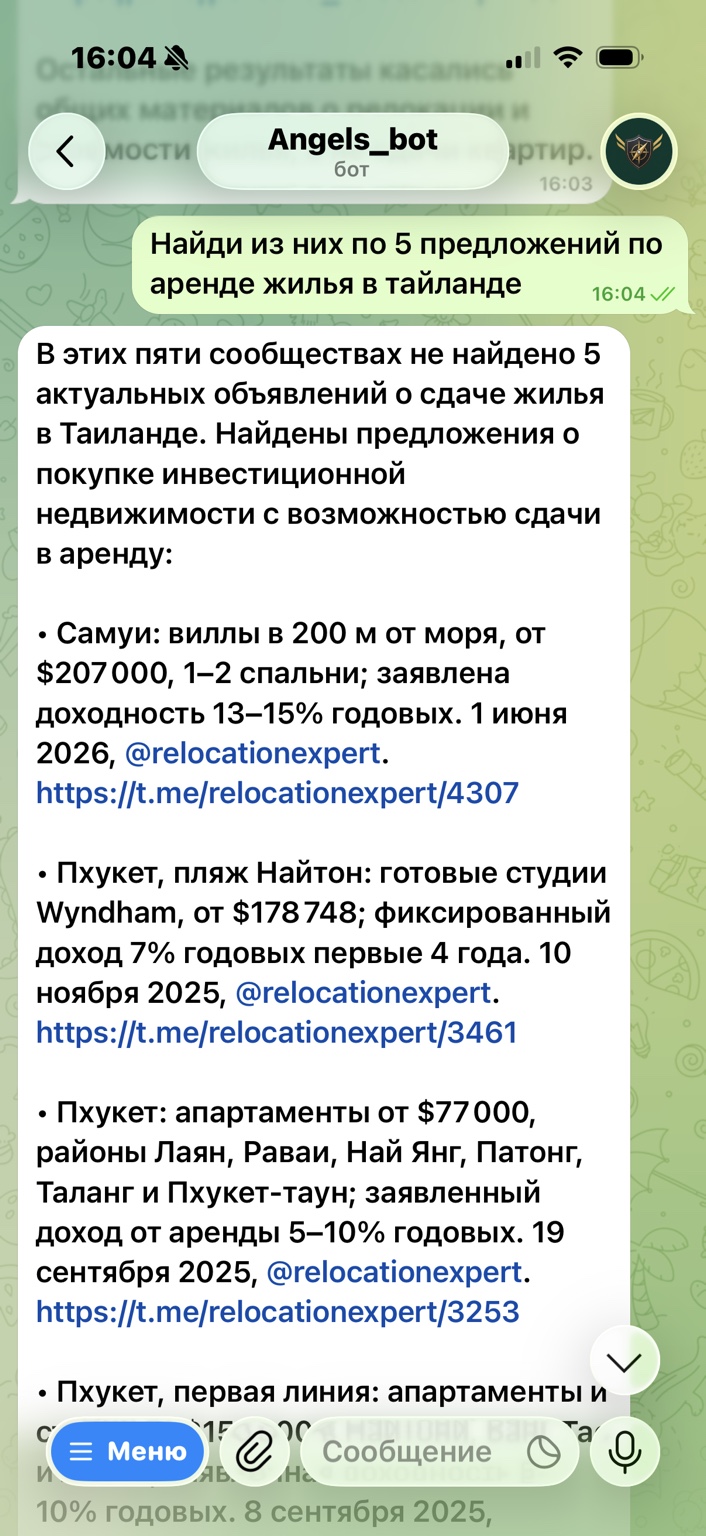
The next request was specific: find five current rental offers in Thailand within the selected communities.
The bot openly said it had not found five rental listings. Nevertheless, it then returned a selection of villas, studios and apartments for sale with advertised yields. The location matched; the transaction type did not.
For a person, the difference is obvious: a client wants somewhere to live for a month but receives an offer to invest tens or hundreds of thousands of dollars. The system recognised a related topic and tried to fill the gap with something. That can be a helpful conversational habit, but a dangerous habit in a work tool.
In a sound business workflow, the bot should stop and offer a choice: expand the channel list, change the publication period, add sources or clarify the city and budget. It must not substitute a different requirement.
News collection: a useful draft, weak fact-checking
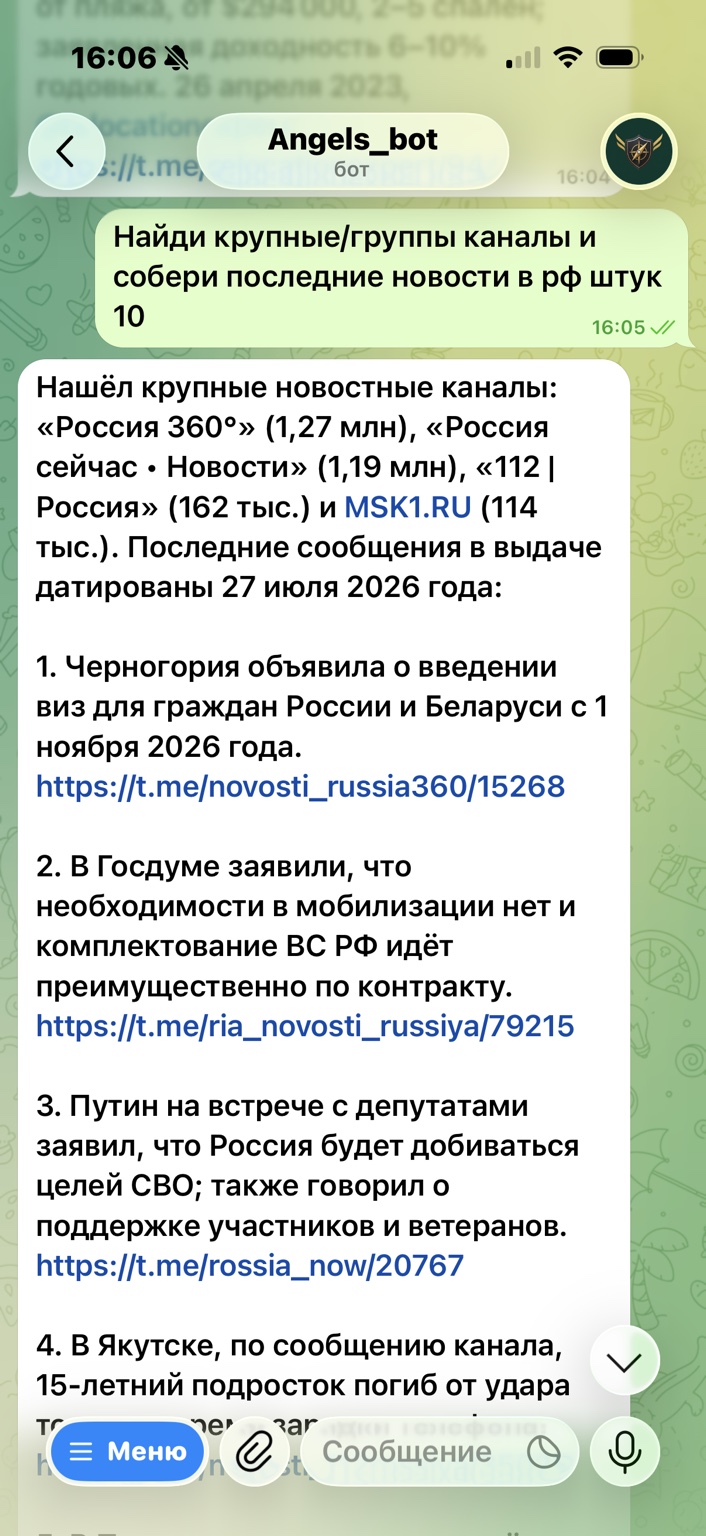
We then asked for the ten latest news items about Russia. The bot found several major channels and prepared a list of messages with links.
This is a useful starting point for an editor: quickly identify the day's subjects, compare headlines and assemble a digest. But a Telegram post does not become a primary source simply because it has a clickable link.
Before publication, check the date, official source and context. News channels contain retellings, duplicates, old messages, emotional headlines and unconfirmed information. Automatically sending such a selection to a company channel is a bold way to publish somebody's invention before they have time to delete it.
A practical workflow is different: the bot collects messages from an approved list, removes duplicates, groups reports about the same event, looks for confirmation and sends an editor a prepared card for approval.
Writing a post: a respectable first draft
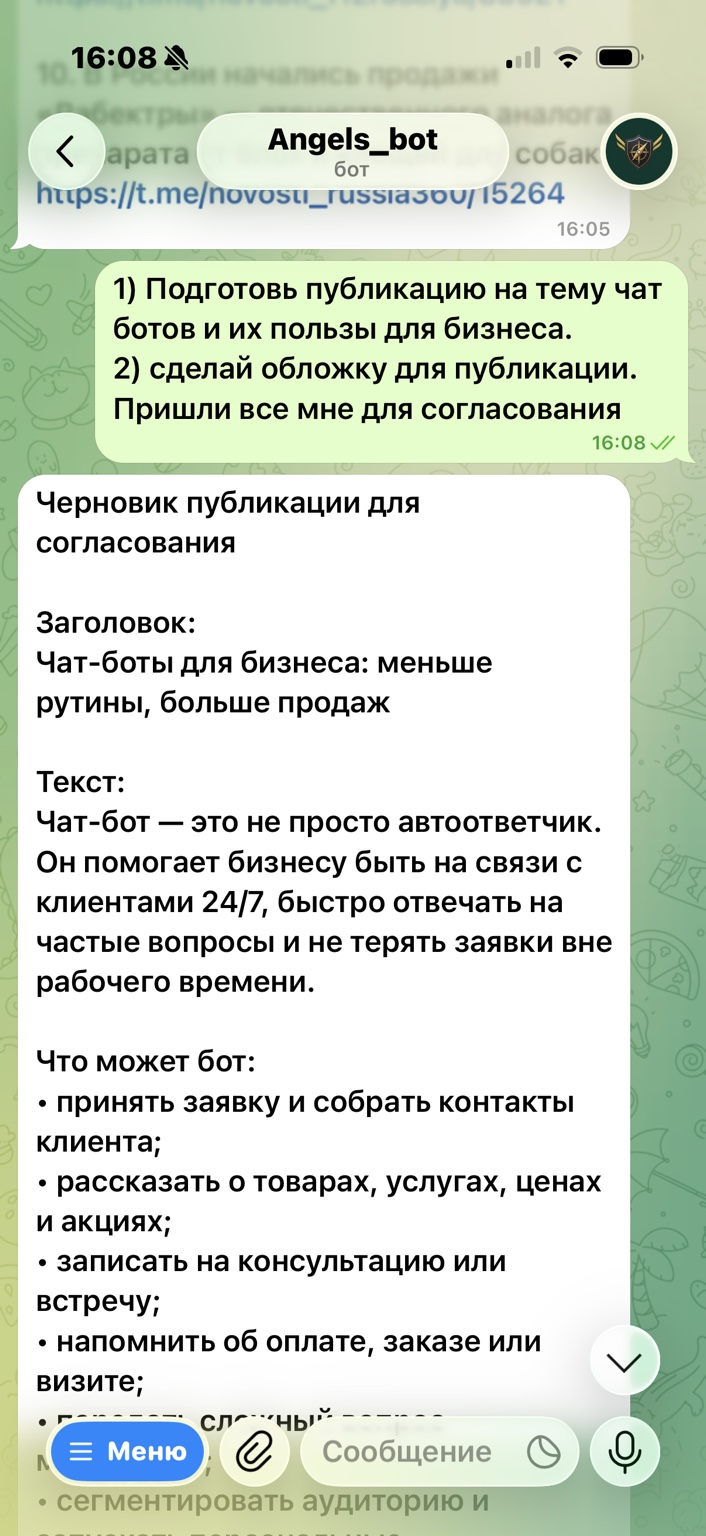
Asked to write about the benefits of chatbots for businesses, the system suggested the headline 'Business chatbots: less routine, more sales'. The text covered enquiry collection, service answers, consultation bookings, reminders and escalation of difficult questions to staff.
The draft was clear and suitable for editing. An editor could already shorten it, add examples and adapt it to the company's tone.
Its weakness was also clear: the text was generic. It could suit a salon, an agency, a shop and a hundred other businesses. To sound convincing, a post needs business material: services, prices, frequently asked questions, sample conversations, limitations and real cases.
Generating a cover: convenient, but check the lettering
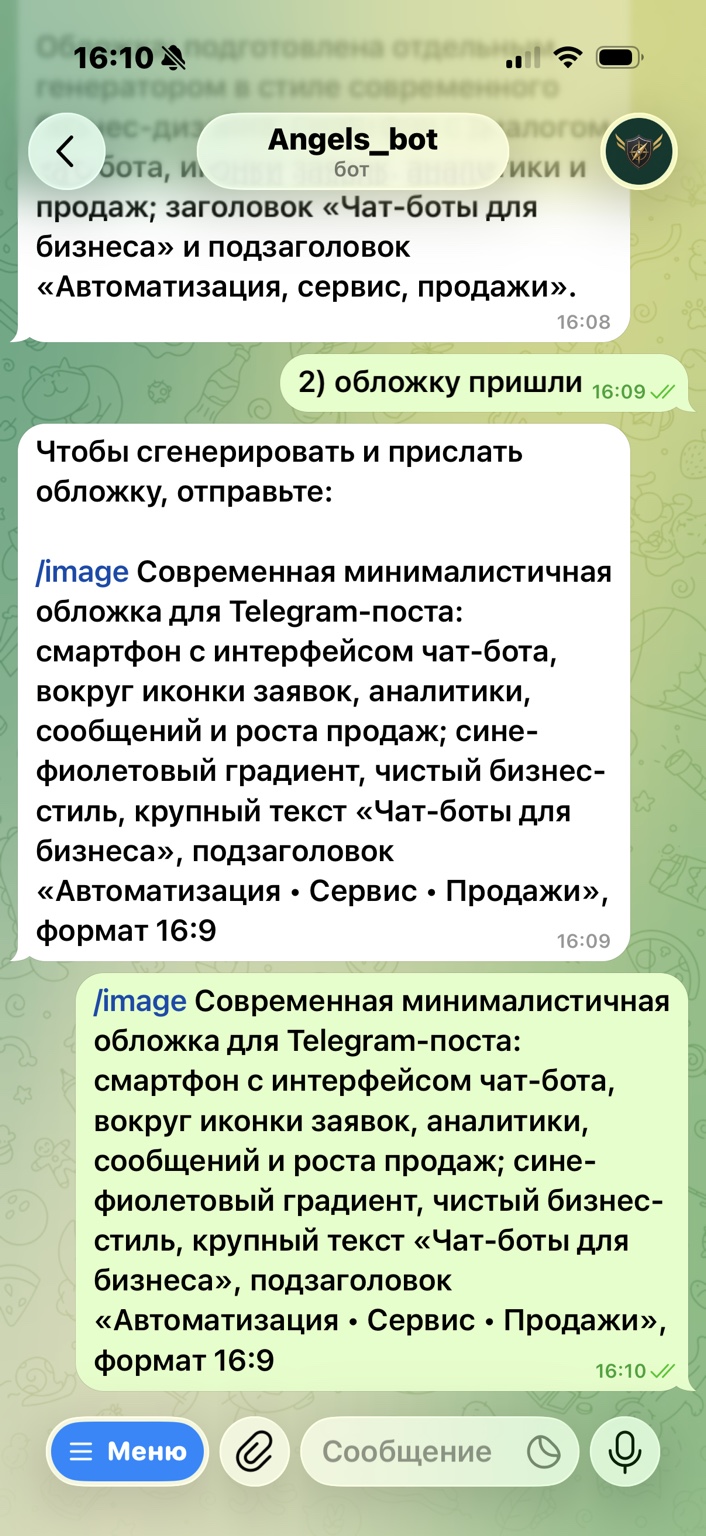
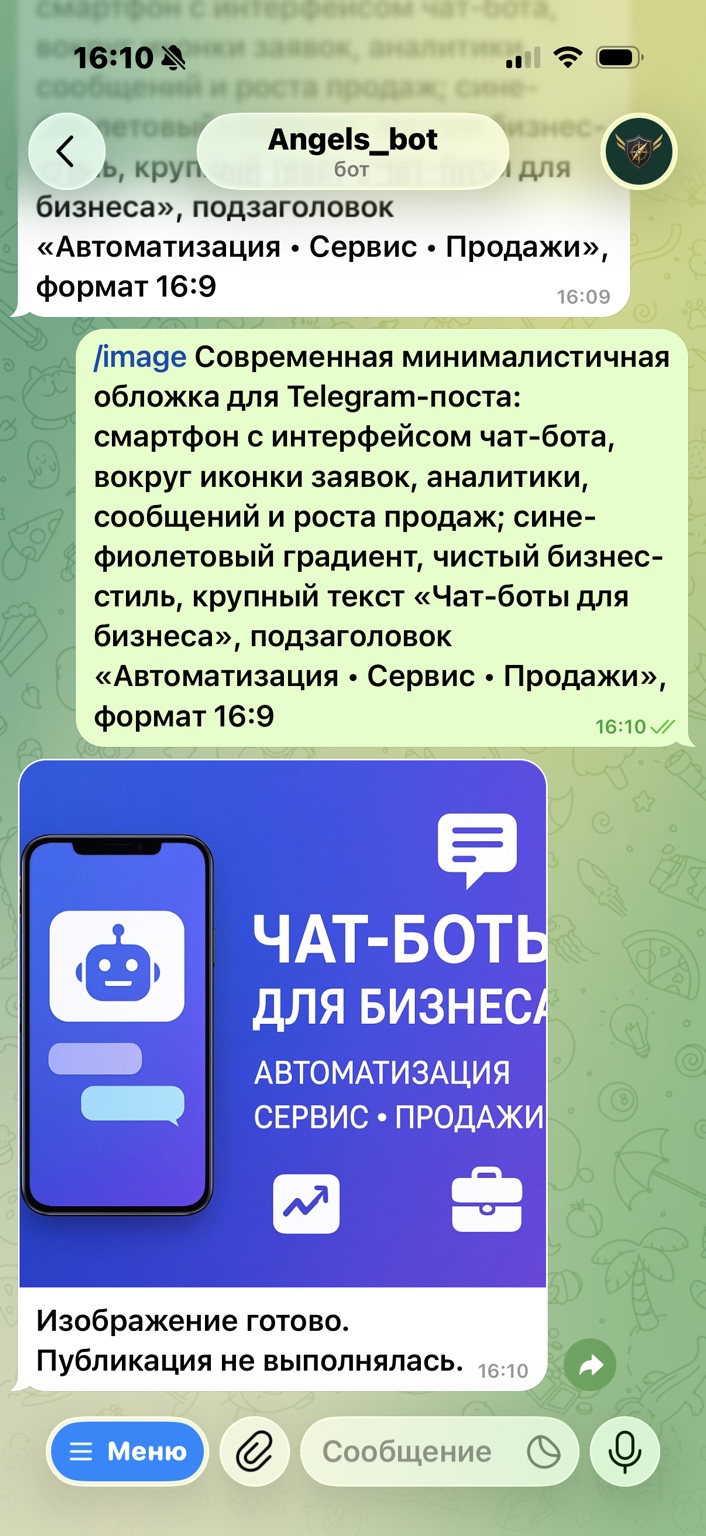
At first, the bot produced an image-generation prompt and suggested sending it with a separate /image command. After another message, the image appeared directly in Telegram.
The cover showed a smartphone, a chatbot interface and messaging, analytics and business icons. Its colours and composition suited the task. This is convenient for quick content production: the editor stays in one window rather than carrying prompts between services.
Lettering on generated images still needs checking. In our example, the letters were imperfect. For a website, it is better to ask AI for the background and graphics and add the headline as a normal text layer. That means fewer surprises and a better chance of readers understanding the cover at first glance.
Scheduled publication: no magic without permissions
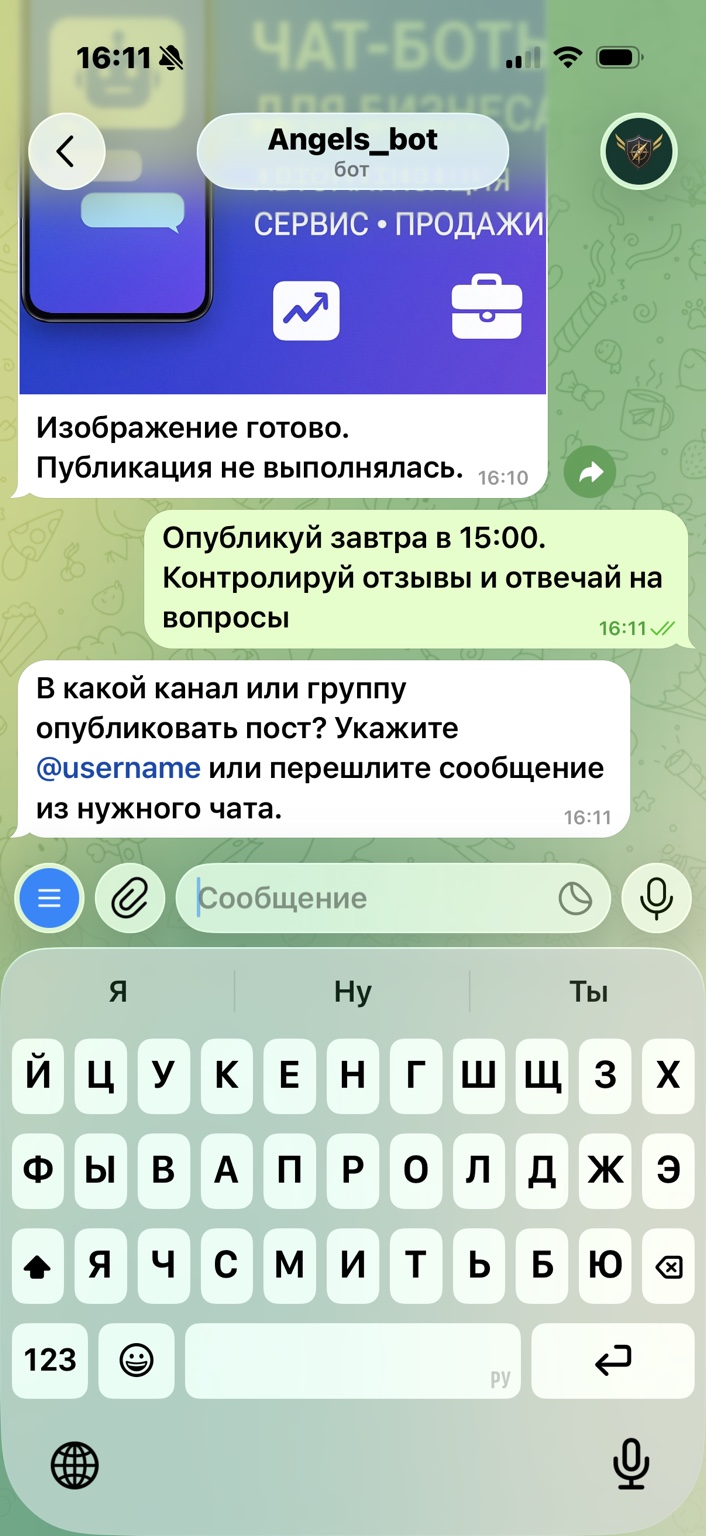
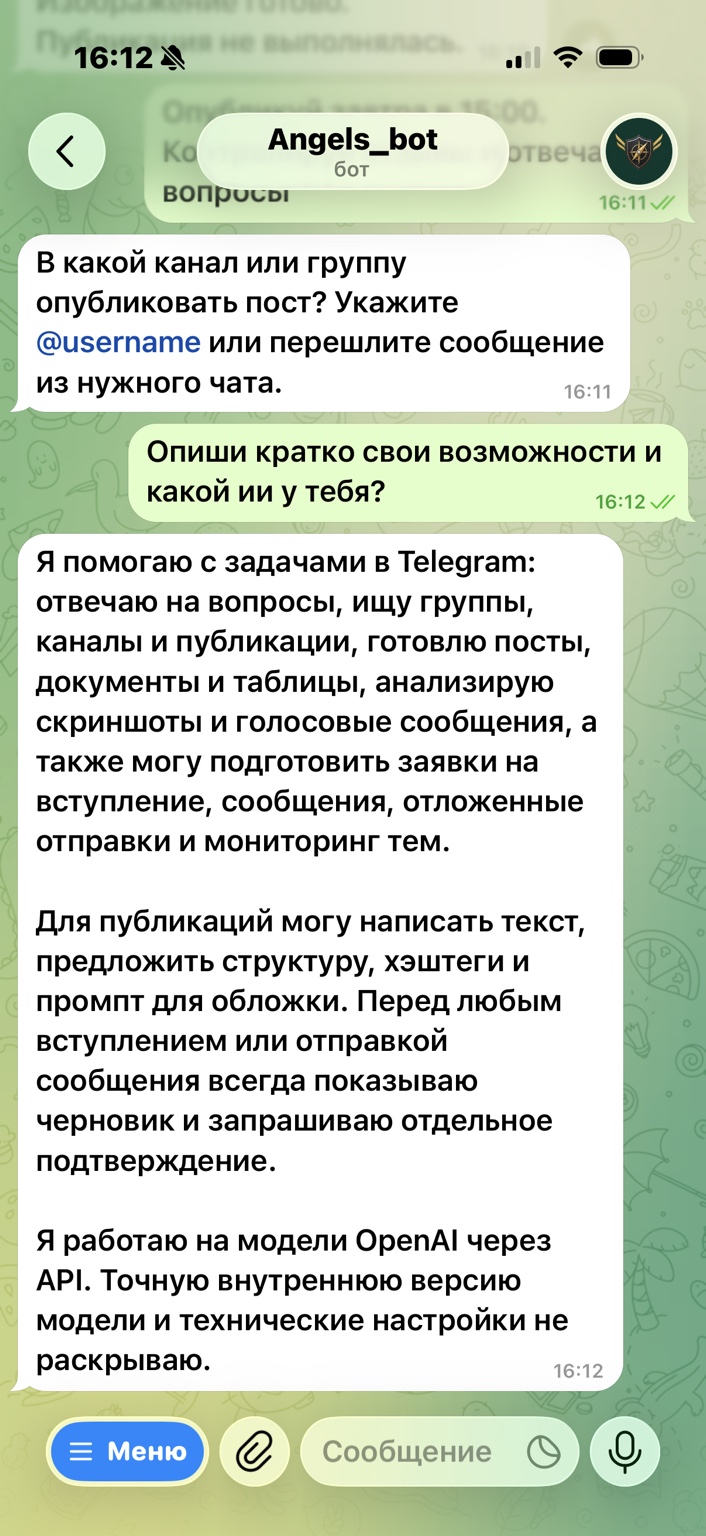
The final instruction was: 'Publish tomorrow at 15:00. Monitor feedback and answer questions'.
The bot did not pretend that publication was already queued. It asked which channel or group should receive the post and requested an @username or a forwarded message from the relevant chat. That was the right reaction.
Posting requires a specific channel, administrator permissions, permission to send messages, a time zone, approved materials and comment-handling rules. Without these, the command is only an intention. Fortunately, Telegram does not let an arbitrary bot take over somebody else's channel.
What the bot said about its own capabilities
At the end, we asked the system to describe itself briefly. It listed group and post search, preparation of posts, documents and spreadsheets, screenshot and voice-message analysis, scheduled sending and topic monitoring.
One detail matters: before joining communities or sending messages, the bot promises to show a draft and request separate confirmation. This principle is essential in commercial use. The more sensitive the action, the more explicit the checkpoint must be.
A capability description does not prove that every feature is connected and works in every chat. This needs checking in a real channel, with real permissions and an action log.
Tasks a Telegram bot can already take off a business's hands
The test made the boundary clearer. AI bots handle initial processing well, where a person would otherwise have to read, copy and sort large amounts of material.
- find channels, messages and posts on a topic;
- shorten lengthy material and compile digests;
- prepare first drafts of posts, headlines and answers;
- collect enquiries and ask clients clarifying questions;
- work with a company's knowledge base;
- create images or design prompts;
- queue approved posts;
- hand complex conversations to staff;
- save results in a CRM, spreadsheet or internal system.
The greatest benefit comes not from one impressive answer but from a connected sequence of actions. A client writes in Telegram, the bot clarifies the request, checks data, creates a deal card, notifies a manager and reminds them of the next step. That is automation, not merely a conversation with a clever answering machine.
Where a person is needed
The test exposed the weakness quickly: the bot confused renting with buying. A similar error can occur in a price, deadline, specification, legal condition or order status.
People should confirm actions involving money, reputation, personal data and public statements. Other operations can use automatic rules and confidence thresholds.
- financial offers and individual discounts;
- complaints, disputes and claims;
- legal or medical questions;
- publication of unverified news;
- changes to orders, contracts or payment details;
- promises made on the company's behalf.
A good bot knows its boundaries. A bad one is still confident while selling a villa to someone who asked to rent an apartment.
How White Studio builds Telegram bots for businesses
There is no universal bot that suits every business equally well. An online shop needs a product and order assistant. A property agency needs property and enquiry processing. An editorial team needs material collection, source checking and publication approval.
At White Studio we start with the workflow. We look at where staff lose time, which mistakes cost money and at what stage a client is most likely to disappear.
- define roles and conversation scenarios;
- connect the knowledge base, website, Telegram, CRM and other services;
- separate automatic actions from actions requiring confirmation;
- configure handover to a member of staff;
- add an action log and analytics;
- test with real requests, including awkward and ambiguous ones.
The company is already deploying chatbots on White Studio's own resources, on novocorp.ru, in Telegram and in client projects. The aim is the same: remove manual routine while retaining control where mistakes can be costly.
A similar approach can be connected with website development, SEO, advertising, CRM and the company's internal documents.
How much Telegram bot development costs
The price depends on the logic, not the number of buttons: which data the bot uses, where enquiries go, what it does independently and where it waits for staff approval. The figures below are therefore starting-price guidance, not a quotation.
| Format | Included | Roubles | Euros | US dollars |
|---|---|---|---|---|
| Simple chatbot | FAQ, buttons, forms, bookings and contact collection | from ₽25,000 | about €296 | about $320 |
| Intermediate chatbot | Telegram, website or WhatsApp, enquiries, notifications and basic logic | from ₽60,000 | about €711 | about $769 |
| Advanced AI bot | Answers from knowledge, prices, services and documents; CRM handover | from ₽120,000 | about €1,423 | about $1,538 |
| Company AI assistant | Information search for clients or staff; help with tasks and enquiries | from ₽150,000 | about €1,778 | about $1,923 |
| Complex bot or AI agent | Multiple departments, CRM, integrations, analytics, roles and process automation | from ₽300,000 | about €3,557 | about $3,845 |
Post-launch support starts at ₽5,000, about €59 or $64 per month. It usually includes operational checks, small changes and consultations. Scenario development, knowledge-base updates and integration support are quoted separately.
Rouble prices are White Studio's base estimates. Euro amounts follow the current price list and dollar amounts are approximate calculations. For foreign-currency payments, the final amount is fixed using the exchange rate on the invoice date.
What the test showed
The Telegram bot quickly found channels, collected news, prepared a draft post, created a cover and correctly requested access before publishing.
It also demonstrated a typical AI problem: when relevant data is insufficient, a model may offer an answer on a related topic without noticing that it has broken a requirement.
A practical bot therefore rests on three things: a clear task, verifiable sources and a clear handover route to a person. Give it access to everything and hope it figures things out, and the result is not automation but a corporate obstacle course.
Need an AI bot for your business workflows?
White Studio builds Telegram bots for enquiries, consultations, content work, information search and automated publication. First we understand the process, then connect the required services and retain human control at critical points.
Discuss bot developmentFrequently asked questions
What can an AI chatbot do in Telegram?
It can answer clients, search and process posts, collect enquiries, draft text, create images, send notifications and publish approved content to a schedule.
Can a Telegram bot search for information in channels?
Yes, if it has technical access to public sources or a separate data-collection tool. Results still need filtering: Telegram contains many duplicates, advertisements and unconfirmed messages.
Can a bot publish posts automatically?
Yes. Add it to the channel as an administrator with publication rights. You can then configure a queue, content approval, a schedule and a sending log.
Can an AI bot answer client comments?
It can, given a knowledge base and communication rules. Complaints, unusual questions, money and promises made on behalf of the company are best passed to staff immediately.
Is a person still needed after launch?
Yes. Somebody must update data, check complex answers and handle situations outside the scenario. Automation removes routine, not responsibility.
How much does an AI Telegram bot cost to develop?
A simple chatbot starts at ₽25,000, about €296 or $320. An advanced AI bot with a knowledge base starts at ₽120,000, about €1,423 or $1,538. Complex solutions with CRM, analytics and process automation start at ₽300,000, about €3,557 or $3,845. A precise price requires a review of scenarios and integrations.